# STTN for Video Inpainting
### [Paper](https://arxiv.org/abs/2007.10247) | [Project](https://sites.google.com/view/1900zyh/sttn) | [Slides](https://drive.google.com/file/d/1y09-SLcTadqpuDDLSzFdtr3ymGbjrmyi/view?usp=sharing) |[BibTex](https://github.com/researchmm/STTN#citation)
Learning Joint Spatial-Temporal Transformations for Video Inpainting
[Yanhong Zeng](https://sites.google.com/view/1900zyh), [Jianlong Fu](https://jianlong-fu.github.io/), and [Hongyang Chao](https://scholar.google.com/citations?user=qnbpG6gAAAAJ&hl).
In ECCV 2020.
## Citation
If any part of our paper and repository is helpful to your work, please generously cite with:
```
@inproceedings{yan2020sttn,
author = {Zeng, Yanhong and Fu, Jianlong and Chao, Hongyang,
title = {Learning Joint Spatial-Temporal Transformations for Video Inpainting},
booktitle = {The Proceedings of the European Conference on Computer Vision (ECCV)},
year = {2020}
}
```
## Introduction
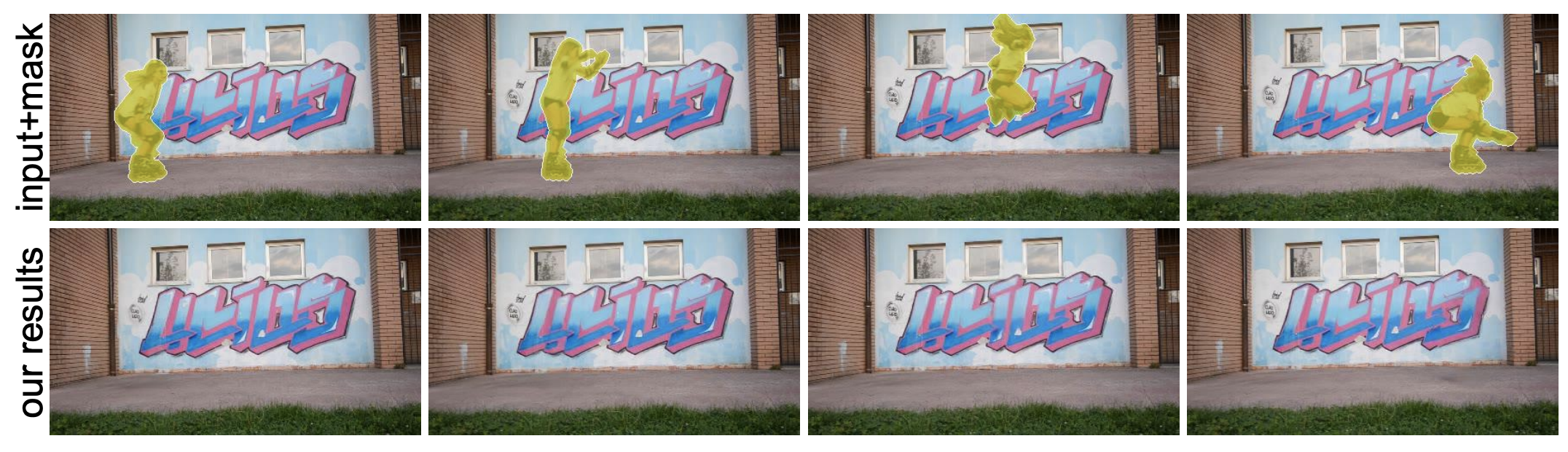
High-quality video inpainting that completes missing regions in video frames is a promising yet challenging task.
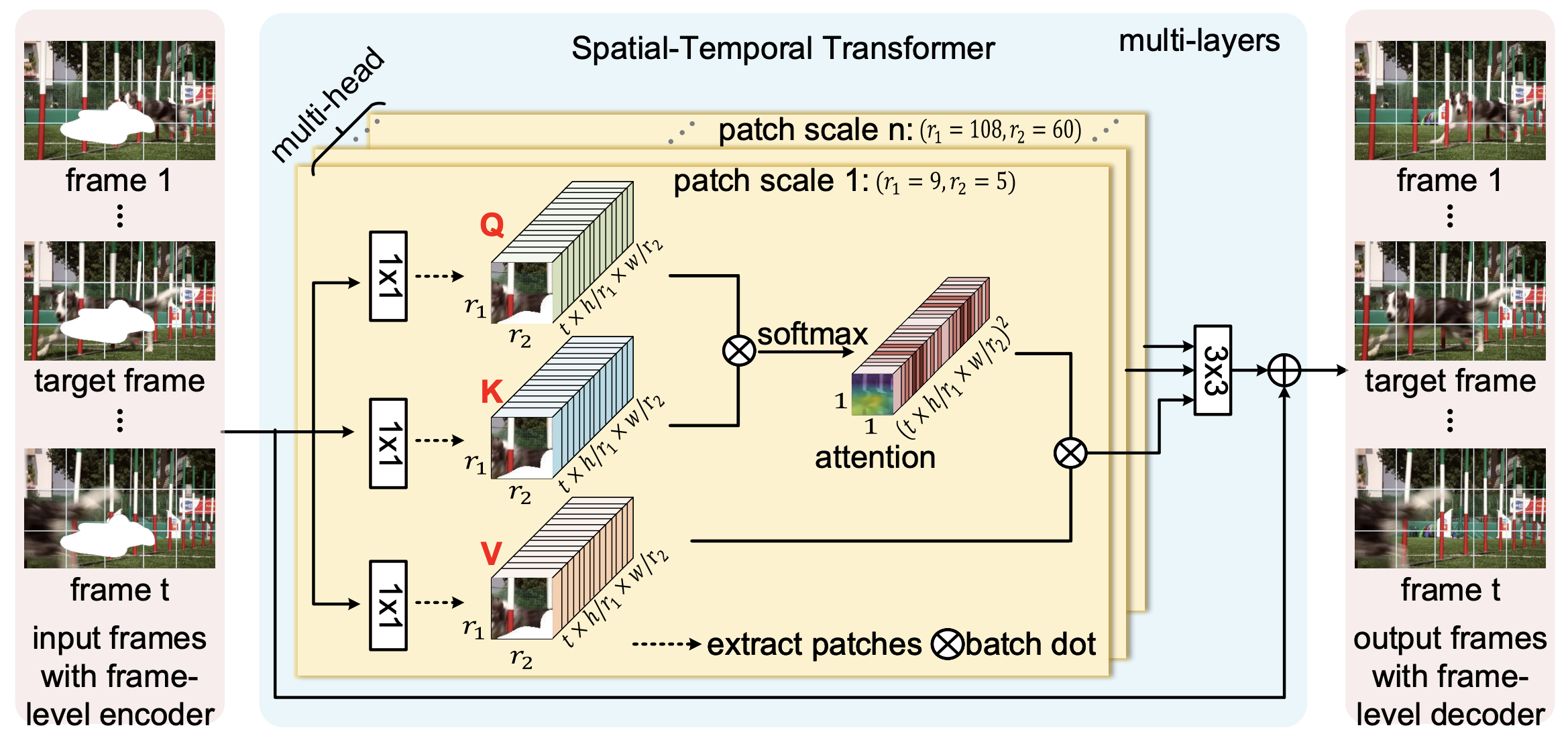
In this paper, we propose to learn a joint Spatial-Temporal Transformer Network (STTN) for video inpainting. Specifically, we simultaneously fill missing regions in all input frames by the proposed multi-scale patch-based attention modules. STTN is optimized by a spatial-temporal adversarial loss.
To show the superiority of the proposed model, we conduct both quantitative and qualitative evaluations by using standard stationary masks and more realistic moving object masks.
## Installation
Clone this repo.
```
git clone git@github.com:researchmm/STTN.git
cd STTN/
```
We build our project based on Pytorch and Python. For the full set of required Python packages, we suggest create a Conda environment from the provided YAML, e.g.
```
conda env create -f environment.yml
conda activate sttn
```
## Completing Videos Using Pretrained Model
The result videos can be generated using pretrained models.
For your reference, we provide a model pretrained on Youtube-VOS([Google Drive Folder](https://drive.google.com/file/d/1ZAMV8547wmZylKRt5qR_tC5VlosXD4Wv/view?usp=sharing)).
1. Download the pretrained models from the [Google Drive Folder](https://drive.google.com/file/d/1ZAMV8547wmZylKRt5qR_tC5VlosXD4Wv/view?usp=sharing), save it in ```checkpoints/```.
2. Complete videos using the pretrained model. For example,
```
python test.py --video examples/schoolgirls_orig.mp4 --mask examples/schoolgirls --ckpt checkpoints/sttn.pth
```
The outputs videos are saved at ```examples/```.
## Dataset Preparation
We provide dataset split in ```datasets/```.
**Preparing Youtube-VOS (2018) Dataset.** The dataset can be downloaded from [here](https://competitions.codalab.org/competitions/19544#participate-get-data). In particular, we follow the standard train/validation/test split (3,471/474/508). The dataset should be arranged in the same directory structure as
```
datasets
|- youtube-vos
|- JPEGImages
|- .zip
|- .zip
|- test.json
|- train.json
```
**Preparing DAVIS (2018) Dataset.** The dataset can be downloaded from [here](https://davischallenge.org/davis2017/code.html). In particular, there are 90 videos with densely-annotated object masks and 60 videos without annotations. The dataset should be arranged in the same directory structure as
```
datasets
|- davis
|- JPEGImages
|- cows.zip
|- goat.zip
|- Annoatations
|- cows.zip
|- goat.zip
|- test.json
|- train.json
```
## Training New Models
Once the dataset is ready, new models can be trained with the following commands. For example,
```
python train.py --config configs/youtube-vos.json --model sttn
```
## Testing
Testing is similar to [Completing Videos Using Pretrained Model](https://github.com/researchmm/STTN#completing-videos-using-pretrained-model).
```
python test.py --video examples/schoolgirls_orig.mp4 --mask examples/schoolgirls --ckpt checkpoints/sttn.pth
```
The outputs videos are saved at ```examples/```.
## Visualization
We provide an example of visualization attention maps in ```visualization.ipynb```.
## Training Monitoring
We provide traning monitoring on losses by running:
```
tensorboard --logdir release_mode
```
## Contact
If you have any questions or suggestions about this paper, feel free to contact me (zengyh7@mail2.sysu.edu.cn).